

Speight! Opera's P.T. Barnum
A reporter's memories

When a friend let me know this week that former Seattle Opera General Director Speight Jenkins died this past weekend (May 30) I was shocked, although I don’t really know why.
Speight (that’s what we all called him) was 89 years old and the last time I saw him a few years back he was frail and walking gingerly across the Seattle Center lawn, with assistance. But somehow the indomitable force that had been Speight Jenkins seemed as if he would defy death. Alas, he was mortal, like the rest of us.
Although he wasn’t death defying, Speight was a force, a man so passionate about his beloved opera that he had the power to lure me to productions that even my mother (a far more avid opera fan) shunned.
One of the first stories I ever produced for National Public Radio (NPR) was about Speight’s first full Ring Cycle at Seattle Opera in the summer of 1986. Seattle Opera had presented Richard Wagner’s epic four-opera 15 hour extravaganza before Speight took his job in 1983, but it became, for me, Speight’s signature, a mammoth undertaking that drew international audiences, some who attended clad in Valkyrie-themed horned helmets or sparkling capes, or both.
I remember standing at a pay phone in Bellingham (kids, ask one of your elders what that is), trying to convince my NPR editor in the other Washington that we weren’t all lumberjacks way out here in the Pacific Northwest, that we actually could generate high quality art. This pioneering city hadn’t yet exploded onto the international rock music scene. That would happen almost a decade later. And Seattle hadn’t yet become a test site for potential Broadway musicals. The Northwest was uncharted territory for culture mavens.
Speight put out an irresistible siren call, luring art lovers here every summer, finding the funds he needed to build an opera empire from very generous acolytes. He produced a Ring Cycle every few years, but summers also brought us a host of other Wagnerian gems.
Aside from his stage productions, Speight also helped spur the renovation of the Opera House. It reopened in 2003 as Marion Oliver McCaw Hall, the current home theather for both the Opera and Pacific Northwest Ballet. I have a clear memory of the opening press walk through the hall, where Speight proudly told the gathered journalists about how the women’s restrooms would have enough toilet stalls to accommodate our full bladders. A friend who worked for Seattle Opera at the time recalls his bathroom pride, and the fact that his mother suggested those bathrooms be rendered in tones of pink because that color was most flattering.
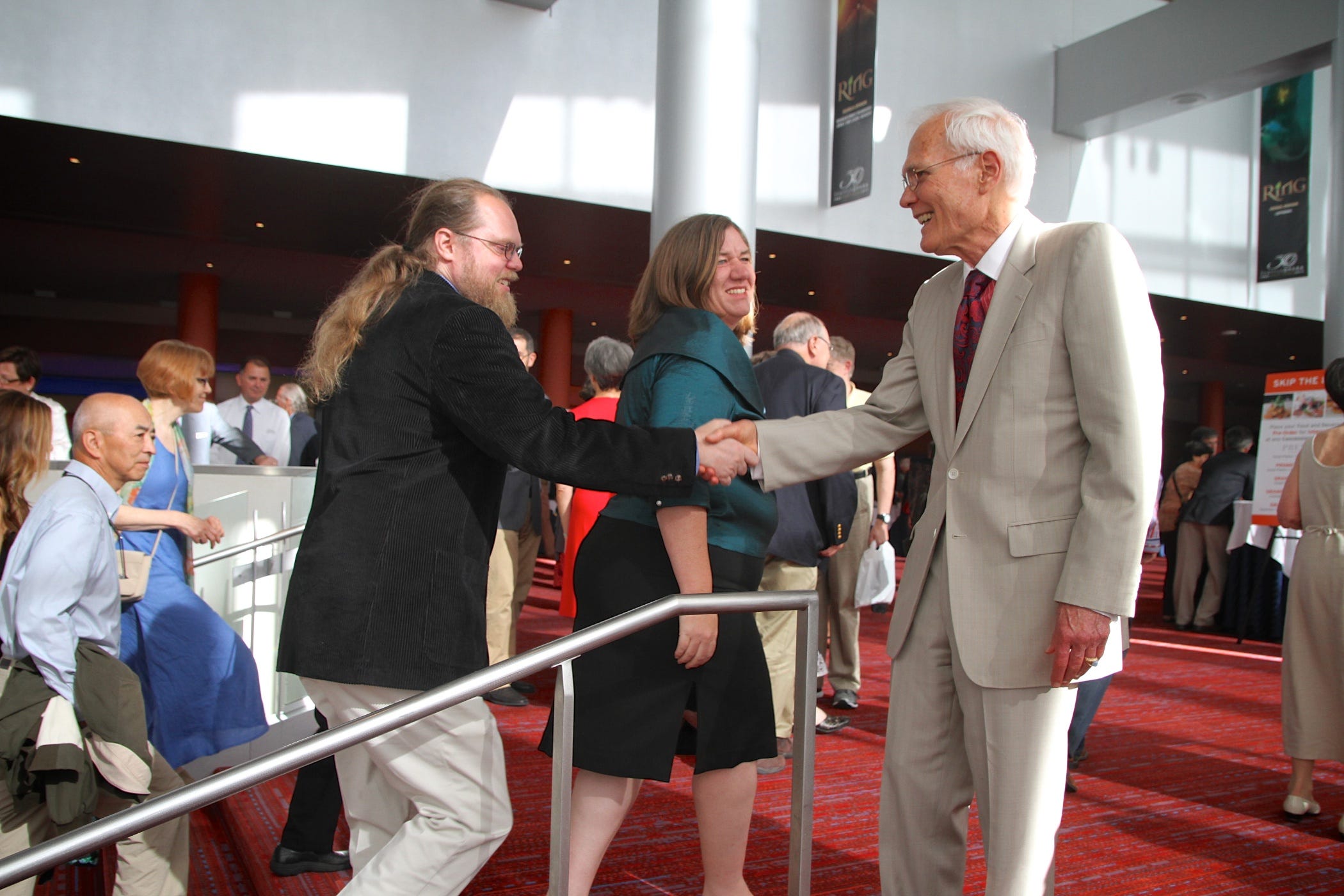
And Speight would stand proudly at the top of McCaw Hall’s grand staircase, greeting as many audience members as he could, whether he knew us or not.
One of my last work conversations with Speight took place after he retired in 2014. His successor was trying to lay the blame for the Opera’s financial shortfalls at Speight’s feet, and in turn, Speight was calling me in a feverish effort to clear his name. The situation was fraught because, while Speight may not have conducted business as usual at Seattle Opera, I’m pretty sure he covered his costs. And over his decades in Seattle, he was able to transform a solid regional arts organization into an international beacon.
Seattle is now a tech hub, luring giant yachts like Mark Zuckerberg’s into our traditional maritime waters. Newcomers may not recognize the names of people like Speight Jenkins, or Bagley and Virginia Wright, or Peter Donnelly, who helped transform this city on the Sound into an arts hub. But Speight was truly visionary as well as scary and endearing and absolutely devoted to opera. And in my decades of covering Seattle, he was one of the people who stood out to me as helping to define Seattle. Right up there with Bill Boeing, Jimi Hendrix, Kurt Cobain and Ichiro.
Speight used to tell a story about himself as a young boy in Texas, hanging out in a tree listening to the regular Saturday radio broadcasts of the Metropolitan Opera. Speight eventually became a regular voice on that program, before taking over the reins at Seattle Opera. Like everything, Speight forged his groundbreaking career his way, and we have reaped the bounty.
Speight, thank you for everything you brought with you. May your memory be a blessing for us all.
"I have a clear memory of the opening press walk through the hall, where Speight proudly told the gathered journalists about how the women’s restrooms would have enough toilet stalls to accommodate our full bladders." I was at that press conference as well -- it seemed like every other slide in the Power Point deck promised twice as many stalls for women. I applauded with every slide.
Thanks for a great historical perspective. I would say maestro Gerard Schwarz and his 26-year Seattle arts influence would also be in that upper echelon.